 |
| Salvador Dali, Head Bombarded with Grains of Wheat, 1954 |
 |
| Louis Welden Hawkins, The Mask, 1905 |
 |
| Alphonse Maria Mucha, F. Champenois, 1897 |
Considering the early 20th century origin of this visual trope, I'll be willing to argue without providing research, that the femme-fleur is a formal visual language to associate women's sexuality, sensuality and beauty with nature in a way to deconstruct the power of those characteristics of women. Hair is historically, and cross-culturally, both a symbol of power and sexuality. Men value beards for those reasons. You'll notice that in the European tradition, the reclining female is nude of all pubic hair. Not-depicting pubic hair is a symbolic way of removing the women's power, in a manner similar to the way depictions of African-American men in the early 20th century symbolically castrate them by not showing a zipper, thereby removing the power that comes from their virility, which white men fear. In the definition above, it is the hair itself that is designed to resemble vegetation. Women therefore become the land in this visual language, their sexuality to be harnessed, as the land's vegetation is harnessed, to produce for men. This is done through the association of hair and sexual power, and the idea of the passivity of land that needs to be cultivated and improved in order to yield produce, production. Reclining nudes are meant to convey passivity of the female body and land as it started with Giorgione, and then was moved into a domestic space to imply the domestication of women/nature.
 |
| Giorgione, Sleeping Venus, 1510 |
 | |
| Titian, Venus of Urbino, 1538 |
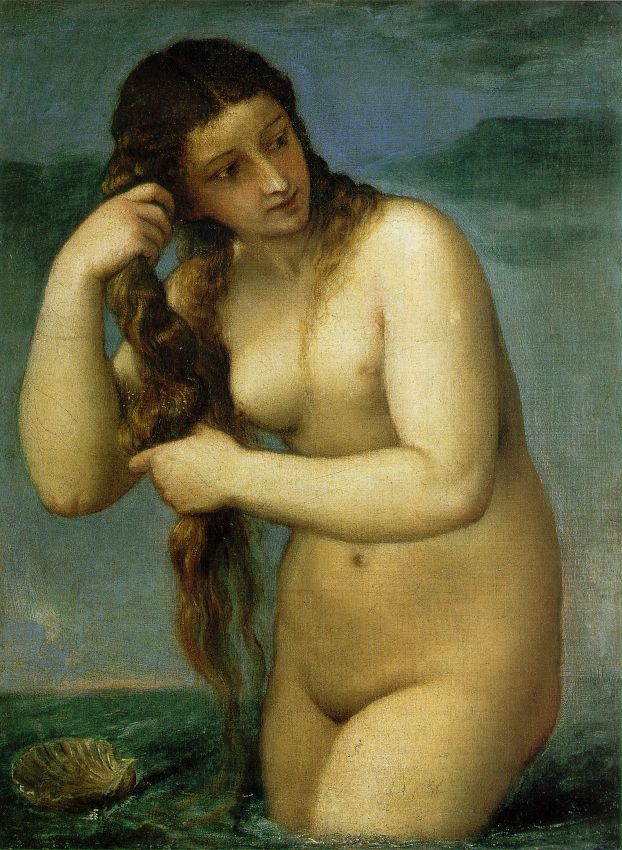 |
| Titian, Venus Anadyomene, 1525 |
 | ||||
| William-Adolphe Bouguereau, The Birth of Venus, 1879 |
 |
| Gustav Klimt, I couldn't find the title, but let's call her Woman Submitting, 1862-1918 |
 |
| Women in a garden, Domestification of women and nature |
 | ||
| Reminds me of the Little Mermaid. Not a coincidence. |
So, obviously, this is a particular form of objectification of women in art and visual culture that is detrimental to how we perceive ourselves and how we are perceived. Just like in Susan's book though, that inspires this blog, there is space within this association to claim our power back. First, some words from Susan.
Prologue
"He says that woman speaks with nature. That she hears voices from under the earth. That wind blows in her ears and trees whisper to her. That the dead sing through her mouth and the cries of infants are clear to her. But for him this dialogue is over. He says he is not part of this world, that he was set on this world as a stranger. He sets himself apart from women and nature.
And so it is that Goldilocks who goes to the home of the three bears, Little Red Riding Hood who converses with the wold, Dorothy who befriends a lion, Snow White who talks to the birds, Cinderella with mice as her allies, the Mermaid who is half fish, Thumbelina courted by a mole. (And when we hear in the Navaho chant of the mountain that a grown man sits and smokes with bears and follows directions given to him by squirrels, we are surprised. We had thought only little girls spoke with animals.)
We are the bird's eggs. Bird's eggs, flowers, butterflies, rabbits, cows, sheep; we are caterpillars; we are leaves of ivy and springs of wallflower. We are women. We rise from the wave. We are gazelle and doe, elephant and whale, lilies and roses and peach, we are air, we are flame, we are oyster and pearl, we are girls. We are women and nature. And he says he cannot hear us speak.
But we hear.
Her Body (And he makes her body over to his liking)
Hair
...perhaps nothing was so effective as the tormentum
insomniae, the torture of artificial sleeplessness... even those...
stout enough to resist the estrapade would yield to... this slower
but more certain... torture, and confess themselves to be witches.
H.R. Trevor-Roper, The European Witch-Craze
When I think of women, it is their hair that first comes to
my mind. The very idea of womanhood is a storm of hair - black
hair, red hair, brown hair, golden hair, - and always with a greedy
little mouth somewhere behind the mirage of beauty.
Friedrich Nietzsche, My Sister and I
Fine light hairs covering our backbones. Soft hair over our forearms. Our upper lips. The body takes on the adult contour of hips and breasts. Hair tickling our legs. Lying against our cheeks. The accessory reproductive organs reach maturity. Hair rounding over vulvas. Hair curling from under our arms. Our noses. The uterus descends into the pelvis. Hair surprises us. Betrays us. Our secrets. A solution is applied to the skin, excising each strand. The solution is applied again. The solution is applied again. The solution is We are covered in black coarse hair. The follicle is decomposed at the root with an electric
current. Hair grows wild all over our bodies.
 |
| Janine Antoni, Loving Care, 1992 |
 |
| Janine Antoni, Loving Care, 1992 |
"In Loving Care (1992) Antoni uses her hair as a paintbrush and Loving Care hair dye as her paint. Antoni dips her hair in a bucket of hair dye and mops the gallery floor on her hands and knees and in the process pushes the viewers out of the gallery space.[4] Once again, in this process Antoni explores the body, as well as themes of power, femininity, and the style of abstract expressionism." Wikipedia
 |
| Janine Antoni, Loving Care, 1992 |
 |
| Janine Antoni, Loving Care, 1992 |
Loving Care is a masterpiece for the layering and complexity of meaning that develops through the wholeness of art concept, practice and object. In addition, loving care is a slight homophone for long hair. Perfect.
The Zoological
Garden
Wild, wild things will turn on you
You have got to set them free.
Cris Williamson, "Wild Things"
In the cage is the lion. She paces with her memories. Her body is a record of her past. As she moves back and forth, one may see it all: the lean frame, the muscular legs, the paw enclosing long sharp claws, the astonishing speed of her response. She was born in this garden. she has never in her life stretched those legs. Never darted farther than twenty feet at a time. Only once did she use her claws. Only once did she feel them sink into flesh. And it was her keeper's flesh. Her keeper whom she loves, who feeds her, who would never dream of harming her, who protects her. Who in his mercy forgave her mad attack, saying this was in her nature, to be cruel at a whim, to try and kill what she loves. He had some into her cage as he usually did early in the morning to change her water, always at the same time of day, in the same manner, speaking softly to her, careful to make no sudden movement, keeping his distance, when suddenly she sank down, deep down into herself, the way wild animals do before they spring, and then she had risen on all her strong legs, and swiped him in one long, powerful, graceful movement across the arm. How lucky for her he survived the blow. The keeper and his friends shot her with a gun to make her sleep. Through her half-open lids she knew they made movements around her. They fed her with tubes. They observed her. They wrote comments in notebooks. Ad finally they rendered a judgement. She was normal. She was a normal wild beast, whose power is dangerous, whose anger can kill, they had said. Be more careful of her, they advised. Allow her less excitement. Perhaps let her exercise more. She understood none of this. She understood only the look of fear in her keeper's eyes. And now she paces. Paces as if she were angry, as if she were on the edge of frenzy. The spectators imagine she is going through the movements of the hunt, or that she is readying her body for survival. But she knows no life outside the garden. She has no notion of anger over what could have been, or might be. No idea of rebellion
It is only her body that knows of these things, moving her, daily, hourly, back and forth, back and forth, before the bars of her cage.


All of the above drawings are by The White Deer, the pseudonym for Hong-Kong artist Peony Yip, from Wildlife Series. I love how these drawings taken together, there are more, use nature to capture the diversity of womanhood, of human nature, without objectifying either subject, or reducing us to the worst associations of any particular animal. Just like Susan Griffin does with words, Peony Yip finds the space within this association with nature to find our strength, instead of our weakness, and transforms the meaning carried by this long-standing visual tradition.
http://www.facebook.com/TheWhiteDeerIllustrations
http://www.flickr.com/photos/weirdsimplicity/
http://thewhitedeers.tumblr.com/
The Lion in the Den of the Prophets
She swaggers in. They are terrifying in their white hairlessness. She waits. She watches. She does not move. She is measuring their moves. And they are measuring her. Cautiously one takes a bit of her fur. He cuts it free from her. He examines it. Another numbers her feet, her teeth, the length and width of her body. She yawns. They announce she is alive. They wonder what she will do if they enclose her in the room with them. One of them shuts the door. She backs her way toward the closed doorway and then roars. "Be still," the men say. She continues to roar. "Why does she roar?" they ask. The roaring must be inside her, they conclude. They decide they must see the roaring inside her. They approach her in a group, six at her two front legs and six at her two back legs. They are trying to put her to sleep. She swings at one of the men. His own blood runs over him. "Why did she do that?" the men question. She has no soul, they conclude, she does not know right from wrong, "Be still," they shout at her. "Be humble, trust us," they demand. "We have souls," they proclaim, "we know what is right," they approach her with their medicine, "for you." She does not understand this language. She devours them.

No comments:
Post a Comment