Friday, March 16, 2012

Emily L. Hauser


http://emilylhauserinmyhead.wordpress.com/2012/03/15/dear-gop-you-do-know-how-pregnancy-works-right/ 


Dear GOP: You do know how pregnancy works, right?

I have been pregnant four times.
These pregnancies led to the following four results, in this order: abortion, baby, miscarriage, baby.
These pregnancies occurred over a span of many years, across two continents, and in three different homes. There were at least seven different health care professionals involved, my hair styles varied widely, as did my levels of nausea. The only constant, in all four cases, other than me, was the presence of a penis.
It happened to be the penis I eventually married, but regardless, that is how pregnancy works. No matter who you are, no matter your sexuality, ability to reproduce, or family make-up, if there are children in your life, at some point along the way, there was a penis involved.
I mention this only because it seems the GOP may have forgotten.
Because as we trundle along, shaming women for having any kind of sex, ever, that is not entirely focused on producing babies — even if we are married, even if it wasn’t so much “sex” as “rape,” even if having a baby would threaten our health and thus the well-being of the children we already have — we are completely and utterly ignoring the fact that the single, solitary way for humans to reproduce is for sperm to meet egg. And sperm, you may recall, come from penises.
Which are attached to men.
If women are having too much sex, so are men. If women are producing babies, so are men. If women are making irresponsible reproductive choices with which they want to burden “the American people” — so.are.men.
Birth control, abortions, prenatal care, postpartum care, child care — whatever we may think, whatever we may have been told — are not women’s issues. THEY ARE HUMAN ISSUES.
There is a purely incandescent rage that comes over me now on a nearly daily basis over the blatant dehumanization of women that is currently sweeping the nation. It is exhausting. It is heart breaking. It is spirit crushing. And there’s nothing to be done but to continue to feel it, because I refuse to stop fighting for my right, my daughter’s right, my mother’s right, my sister’s right — the inalienable right of all women everywhere — to human dignity.
But every once and a while, a particularly galling aspect of the GOP’s War on Women floats to the top of the filth, and I am gobsmacked anew. And today it is as simple as this: Women do not reproduce on their own.
If the Republican Party is so anxious to control women’s sexuality (and it clearly is), it had better start shaming men, too.
That is, unless its representatives are willing to argue that men are constitutionally incapable of not sticking their junk into the nearest available lady bits, and we gals have all the power.
I, for one, have too much respect for men to buy that.

Thursday, March 15, 2012

The Power of our Crimson Wave!


Ryan McDougle Facebook page
Like so many other male politicians pushing for things like mandatory transvaginal ultra-sounds, Virginia Senator Ryan McDougle is presumably very interested and concerned with the reproductive health of American women. Why else would he bother, no? Based on this assumption, dozens of women have started flooding McDougle's Facebook page with excruciatingly detailed updates on their vaginas.
Some of the more choice examples:
"Hey senator! just a quick hello to let you know that I'm currently ovulating! my vaginal discharge is thick and sticky and smells acidic (probably all the garlic i've been eating!) if you want to note that in the charts you must be keeping on me and my vulva. i'll let you know how i'm doing next week!"
"You know, Senator, I've wished all my life that man would know more about my own vaginal issues than I do, and now you're here! So here it goes, during my last period, I had to use the Super tampons because I had some chunky blood issues. You know, that pesky uterus and all. Maybe you could tell my uterus that all the blood will ooze out in its own time, and not to rush itself into shooting clots out every month. Also, I find it very inconvenient that I wake up in a pool of my own blood on the first and second days of my period. Maybe you can help a sister out?"
"Senator McDougle, I am almost 49 and STILL menstruating with no sign of slowing done! Frankly, I've had enough of this inconvenience- the cost of pads and pain reliever and all the mess-well YOU know how it is. You're an expert on this lady stuff. I was going to ask my gynocologist about this issue, but since you know so much about women's reproductive health, I figured I'd just stop by your Facebook page and ask you."  
The comments are now being deleted from McDougle's wall nearly as fast as they're going up, and naturally the Senator's office has declined to comment. Most likely, the comments won't convince McDougle that female reproductive health shouldn't be his political area of expertise. Even more likely, his Facebook is being furiously purged by his resident "social media" guru before McDougle even sees any of the comments in question. Still, it's always nice to find creative new outlets for letting presumptuous blowhards know that they're full of shit. To put it delicately.


March 15, 2012

Cultural Constraints on Women Leaders

NEW YORK — NEW YORK With hindsight, we may find that the 2016 U.S. presidential race began last week, when Hillary Rodham Clinton made a politically electrifying point. “Why extremists always focus on women remains a mystery to me,” she said at the Women in the World conference in New York. “But they all seem to. It doesn’t matter what country they’re in or what religion they claim. They want to control women.”
At a time when birth control has re-emerged as a political issue in the United States, 94 years after the first legal ruling to permit it, Mrs. Clinton’s comments were an inspiring rallying cry for worried American women. But what about the mystery she identified? Why, as the secretary of state asserted, do extremists, from the Taliban to conservative Christians, want to control women?
An intriguing new study by two professors at the Rotman School of Management at the University of Toronto suggests a possible answer. (Disclosure: I am on the school’s dean’s advisory board.) Soo Min Toh and Geoffrey Leonardelli didn’t set out to discover why extremists want to control women. Their question was more familiar: Why aren’t there more female leaders?
Ms. Toh and Mr. Leonardelli argue that women are held back by “tight” cultures and can emerge more easily as leaders in “loose” cultures. “Tight” cultures are ones that have clear, rigid rules about how people should behave and impose tough sanctions on those who color outside the lines. Socially conformist, homogeneous societies like Japan, Malaysia, Norway and Pakistan are tight cultures.
Tight cultures, Ms. Toh and Mr. Leonardelli believe, hold women back because “cultural tightness provokes a resistance to changing the traditional and widespread view that leadership is masculine.”
Loose cultures, by contrast, do not have clear norms and are more tolerant of deviation from the rules. Heterogeneous societies and countries in the midst of social and political transition, like Australia, Israel, the Netherlands and Ukraine are loose cultures.
These are cultures in which “societal members tend to be more open to change, and this openness may become manifest in changing expectations and attitudes about the masculinity of leadership.”
Here is where Mrs. Clinton’s mystery comes in. Tight cultures are not necessary sexist ones — witness the inclusion of Norway in the list. But extremist subcultures are certainly tight cultures, and they are built on historical assumptions of male dominance. The perspective of Ms. Toh and Mr. Leonardelli helps to explain why these rigid ideologies are so fixated on keeping women down.
But what about the places like Norway: tight cultures where women do extremely well? Ms. Toh’s and Mr. Leonardelli’s answer to that apparent paradox is that, where there has been a top-down decision to support female leaders, tight cultures are very good at executing that directive. That is because these societies are effective at acting on the collective will. If the decision is made to elevate women, tight societies will implement it.
“Although a culturally tight country, Norway ranks high in terms of gender egalitarianism,” the study’s authors point out. In Norway, egalitarianism is not a rebellion against prevailing cultural norms. It is, instead, what Norway’s new top-down consensus requires: “Norway has among the most ambitious equal opportunity legislation in the world that legally requires firms to reach a 40 percent women board representation by 2017.”
The study’s framework also helps to explain one peculiarity of women in the workplace. Tight societies that choose egalitarianism, like Norway, have been good at pushing women into the corporate establishment. Loose societies that are open to change have been good at empowering women more broadly, encouraging them to join the work force and to start their own small businesses.
But the one thing women around the world have failed to do is create paradigm-shifting companies. None of the great technology start-ups — for example, Google, Apple and Facebook — were founded by a woman. Nor were any of the leading hedge funds, the innovators in the world of money, established by a women. Women are not just underrepresented in this space of transformative entrepreneurs — they are entirely absent.
At first blush, this gap seems to contradict the analysis by Ms. Toh and Mr. Leonardelli. After all, start-ups embody a profoundly loose culture. It does not matter whether you are a misfit or an ultraconformist, so long as you have a brilliant idea and are able to implement it.
But the authors point out that leadership is not just about how others view you, it is also about how you view yourself.
Centuries of sexism, they argue, mean that “even when possessing and demonstrating leadership behavior that is superior to others in the group, women leaders may sometimes prefer to cede the formal leadership role to men in the group because they, too, believe that being male or masculine is more leaderlike.”
Loose cultures can counteract those self-imposed stereotypes to some degree. But the final frontier for women, even in societies that allow them to lead established institutions, is to be ruthless and to take big risks, essential qualities in world-changing entrepreneurs. Instead, as the authors found of female entrepreneurs in Malaysia, women often have to “lead as if they were mothers or teachers.”
Chrystia Freeland is global editor at large at Reuters.

Friday, March 9, 2012

National Women's Day

Turbulence
The biosphere does not end where the light gives out.
G. Evelyn Hutchinson, "The Biosphere"

You have sometimes wondered, my dear friend, at the extreme
affection of my nature - But such is the temperature of my soul-
It is not the vivacity of youth, the hey-day of existence. For years
 I have endeavored to calm an impetuous tide - labouring to
make my feelings take an orderly course - It was striving against
the stream.                                                                         
Mary Wollstonecraft, Letters

We heard of this woman who was out of control. We heard that she was led by her feelings. That her emotions were violent. That she was impetuous. That she violated tradition and overrode convention. That certainly her life should not be an example to us.  (The life of the plankton, she read in this book on the life of the earth, depends on the turbulence of the sea) We were told she moved to hastily. Placed her life in the stream of ideas just born. For instance, had a child out of wedlock, we were told. For instance, refused to be married. For instance, walked the streets alone, where ladies never did, and we should have little regard for her, even despite the brilliance of her words. (She read that the plankton are slightly denser than water) For she had no respect for boundaries, we were told. And when her father threatened her mother, she placed her body between them. (That because of this greater heaviness, the plankton sink into deeper waters) And she went where she should not have gone, even into her sister's marriage. And because she imagined her sister to be suffering what her mother had suffered, she removed her sister from that marriage. (And that these deeper waters provide new sources of nourishment) That she moved from passion. From unconscious feeling, allowing deep and troubled emotions to control her soul. (But if the plankton sinks deeper, as it would in calm waters, she read) But we say that to her passion, she brought lucidity (it sinks out of the lights, and it is only the turbulence of the sea, she read) and to her vision, she gave the substance of her life (which throws the plankton back to the light). For the way her words illuminated her life we say we have great regard. We say have listened to her voice asking, "of what materials can that heart be composed which can melt when insulted and instead of revolting at injustice, kiss the rod?" (And she understood that without light, the plankton cannot live and from the pages of this book she also read that the animal life of the oceans, and hence our life, depends on the plankton and thus the turbulence of the sea for survival.) By her words we are brought to our own lives, and are overwhelmed by our feelings which we had held beneath the surface for so long. And from what is dark and deep within us, we say, tyranny revolts us; we will not kiss the rod.


 p 182-183, Woman and Nature: The Roaring Inside Her by Susan Griffin.


Bad Romance: Women's Suffrage


Our Labor
The news seems vague and far off, not as if it were really happening.
It sits on us like an ache. We are trying to ignore it lest the pain
become unbearable.                                 September 5, 1937
                  Hundreds and Thousands, the journals of Emily Carr

All around us, each way we look, we see only whiteness. And the sky itself is heavy with snow which keeps dropping silently whiteness upon whiteness. The only sounds are the sounds of our voices, muffled and small. Yet we speak rarely. Our minds have become as plain as the landscape around us. And the rhythms of our bodies, moving steadily through these drifts, have become slow. Hour after hour things appear to be the same. Yet the drifts grow deeper. This landscape seems to be frozen still, and we cease to believe that under this ice there were ever leaves, ever a soil, that water ever ran, or that trees grow here still. No evidence of these being can reach us. And our memories of this place are sealed from us by this winter; none of the sharp edges of existence reach us, the odors of this place, its taste, blunted. And even the snow itself becomes unreal. Our skin which at first was stung by the cold has now become so cold itself that is does not recognize coldness.  Our feet and our hands which burned with pain are numb. Our vision seems half blinded by the relentless light from the snow. And we have come to believe there is nothing to taste; nothing to smell. We are certain that all that is around us and in us is absolute stillness. This has always been, we tell ourselves. Yet something in us is changing: our hearts beat slower and slower. And we who were so eager to go on think we want to rest here in this place. That it is best not to continue. Our bodies grow very heavy. our eyes are almost closed. We would let ourselves sink into this snow. We would sleep. To end this struggle is mercy, we think. We marvel at how pain has left our bodies. We feel nothing. We dream that this is not really happening. And kindness we say is quietness. We would sleep. But some voice in us labors to wake, cries out so that we are startled, and we work to open our eyes. Our hands reach out into the snow and we wash this ice over our faces. As we awaken, our skin stings again. And as we push our bodies toward movement, we ache, and we feel pain again in our hands and our feet. We shiver. We are on the verge of crying that these chills are unbearable. But we do not sleep. We see clearly where we are now, and we know that it is winter. And suddenly, through this shocking cold, we remember the beauty of the forest lying under this whiteness. And that we will survive this snow if we are away, if we continue. And now we are shouting with all our strength to the other sleepers, now we are laboring in earnest, to waken them.


p 202-203 Woman and Nature: The Roaring Inside Her by Susan Griffin

Monday, March 5, 2012

The Roaring Gal

I Am Gal, Hear Me Roar

By Lily Rothman
It's time to reclaim the female version of "guy."
dragontattooMOVIE_CROP250_post.jpg
MGM


There are countless words you can use to degrade a woman: bitch, slut, whore. The list goes on. But the word that does the most to set us back has nothing to do with outspokenness or sexual choices. It's a word that's used openly, in public, shamelessly, to our faces. In fact, it's the word I—along with most young women I know—use to describe myself.

The worst word to call a woman is girl.

Girls are children. Girls are dependents. Girls can't make their own decisions. And yet, when we talk about feminine achievement, we talk about girl power. Girls, according to Beyoncé, run the world. The character of Lisbeth Salander, self-sufficient though she may be, is a girl with a dragon tattoo. And, most importantly, in real life, among people I know and respect, female colleagues are "girls from work." The women with whom we studied for advanced degrees are "girls from school." A lot's in a name; although we don't mean to hurt each other, the word girl diminishes our maturity, our responsibility, our power. But what alternative do we have?

Even though my feminist heart hurts to admit it, woman is no good.

It's not that there's anything wrong with the word. It's just that to advocate for the use of "woman" rather than "girl" is to ignore the practical truth. If all who identify as female were to go from girl to woman when they turned 18—or 21 or 13 or 16 or at menses or upon graduation or at some other arbitrary milestone—the scales of language would still be unbalanced. At least among English-speaking males, growing up is far more nuanced. A boy doesn't just instantly become a man: he gets to be a guy.

That usage of the word guy dates to the middle of the nineteenth century. Although it had an earlier, pejorative sense, it was by that time, especially in the United States, an all-purpose, informal word. (The phrase "you guys" has been around almost as long.) And there are plenty of reasons why a young man today would opt to be called a guy. For one thing, studies about "emerging adulthood," an idea that has made headlines in the past few years, seem to indicate that the sense of grown-up-ness comes on later in life. A developmentally appropriate 20-something male may not feel like a man. Man, after all, like woman, is a word that carries weight.

That mantle of womanhood can be too heavy—many of us who are the right age to have sympathized with Britney Spears when she sang "I'm Not a Girl, Not Yet a Woman" in 2001 are still stuck in between. As a 20-something female, there are moments, romantic and professional and Shania-Twain-approved, when I feel like a woman. Other times, I really do feel like a girl (though not as often as I am called one). I never feel like a lady except in announcements made also to gentlemen and I only feel like a dame when I watch old movies. What I feel like most of the time is a guy. A female guy.

There is a solution. There is a word to describe this phase. There is a female equivalent of guy. We can reclaim it from the realm of the ridiculous, restore it to its proper place, and use it to even out the inequality in terminology that persists between the sexes. The word is gal, and gal is a great word.

Gal has all the best qualities of guy. It's casual. It's all-encompassing and all-inclusive. It's friendly and fun. It's short and sweet. Like Ms., a word that would solve this problem if only it existed outside courtesy titles, it doesn't say anything about one's marital status. It has an etymological history as long as guy's, and hit its stride as a non-vulgar term at about the same time as its counterpart.

Somewhere the histories of "guy" and "gal" divided. One word became the default and the other became quaint. Quaint is not the goal, nor is cuteness, nor derisive folkiness. That problem with gal was highlighted recently, when Foster Friess, an American businessman who is active in conservative politics, joked that aspirin could be used as a contraceptive if "gals" held it between their knees. Gal has been relegated to the junk-drawer of Americana, of "Buffalo Gal" and "My Gal Sal" and—heaven forbid—Gal Friday.

But, as guy clearly demonstrates, a word that's casual doesn't have to be critical. And there's a time-tested way to change the connotation of words. Reappropriation of language has already been successful with other words for women: the magazine Bitch has 15 years of feminist writing under its belt and this past year saw the rise of the "SlutWalk." Negative words contain within themselves the potential for positivity—Michel Foucault called this concept "reverse discourse"—but the reappropriation has to begin with those who are affected.

Women, young women, us girls: We have to be the ones who start identifying as gals. Then, finally, we'll be women of our word.


This article available online at:
http://www.theatlantic.com/entertainment/archive/2012/03/i-am-gal-hear-me-roar/253910/

Sunday, March 4, 2012

Femme-Fleur: Artistic Representation of Woman and Nature

From encyclopedia.com a  femme-fleur is "The dream-maiden with long strands of hair resembling vegetation tendrils, often intertwined with marine-like plant-forms, found in Art Nouveau designs."

Salvador Dali, Head Bombarded with Grains of Wheat, 1954


Louis Welden Hawkins, The Mask, 1905

Alphonse Maria Mucha, F. Champenois, 1897


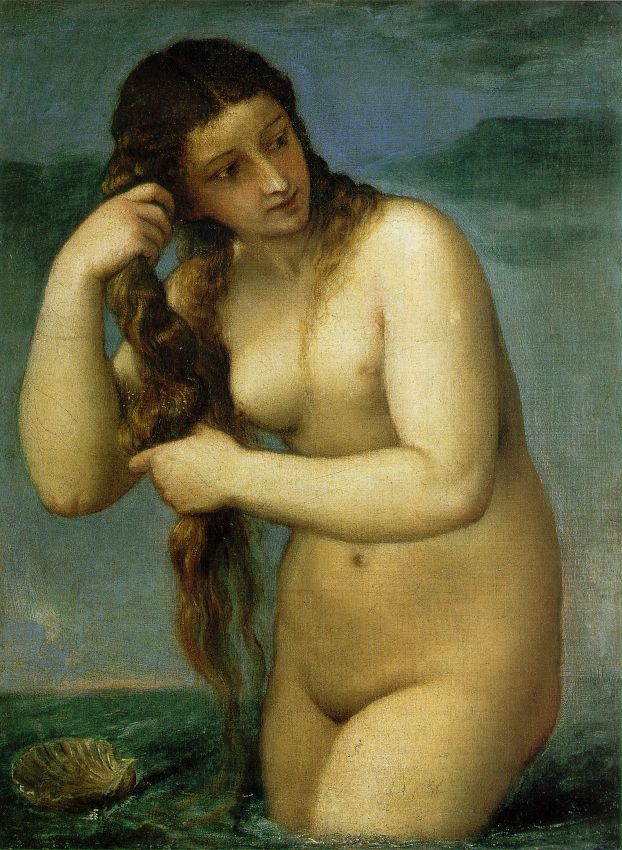
Considering the early 20th century origin of this visual trope, I'll be willing to argue without providing research, that the femme-fleur is a formal visual language to associate women's sexuality, sensuality and beauty with nature in a way to deconstruct the power of those characteristics of women.  Hair is historically, and cross-culturally, both a symbol of power and sexuality. Men value beards for those reasons.  You'll notice that in the European tradition, the reclining female is nude of all pubic hair.  Not-depicting pubic hair is a symbolic way of removing the women's power, in a manner similar to the way depictions of African-American men in the early 20th century symbolically castrate them by not showing a zipper, thereby removing the power that comes from their virility, which white men fear.  In the definition above, it is the hair itself that is designed to resemble vegetation.  Women therefore become the land in this visual language, their sexuality to be harnessed, as the land's vegetation is harnessed, to produce for men.  This is done through the association of hair and sexual power, and the idea of the passivity of land that needs to be cultivated and improved in order to yield produce, production. Reclining nudes are meant to convey passivity of the female body and land as it started with Giorgione, and then was moved into a domestic space to imply the domestication of women/nature.


Giorgione, Sleeping Venus, 1510


Titian, Venus of Urbino, 1538


Titian, Venus Anadyomene, 1525


William-Adolphe Bouguereau, The Birth of Venus, 1879


Gustav Klimt, I couldn't find the title, but let's call her Woman Submitting, 1862-1918


Women in a garden, Domestification of women and nature


Reminds me of the Little Mermaid. Not a coincidence.


So, obviously, this is a particular form of objectification of women in art and visual culture that is detrimental to how we perceive ourselves and how we are perceived.  Just like in Susan's book though, that inspires this blog, there is space within this association to claim our power back.  First, some words from Susan. 

Prologue

"He says that woman speaks with nature.  That she hears voices from under the earth. That wind blows in her ears and trees whisper to her. That the dead sing through her mouth and the cries of infants are clear to her.  But for him this dialogue is over. He says he is not part of this world, that he was set on this world as a stranger. He sets himself apart from women and nature.

And so it is that Goldilocks who goes to the home of the three bears, Little Red Riding Hood who converses with the wold, Dorothy who befriends a lion, Snow White who talks to the birds, Cinderella with mice as her allies, the Mermaid who is half fish, Thumbelina courted by a mole. (And when we hear in the Navaho chant of the mountain that a grown man sits and smokes with bears and follows directions given to him by squirrels, we are surprised.  We had thought only little girls spoke with animals.)

We are the bird's eggs. Bird's eggs, flowers, butterflies, rabbits, cows, sheep; we are caterpillars; we are leaves of ivy and springs of wallflower. We are women. We rise from the wave. We are gazelle and doe, elephant and whale, lilies and roses and peach, we are air, we are flame, we are oyster and pearl, we are girls. We are women and nature. And he says he cannot hear us speak. 

But we hear.


Her Body (And he makes her body over to his liking)

Hair

...perhaps nothing was so effective as the tormentum 
insomniae, the torture of artificial sleeplessness... even those...
stout enough to resist the estrapade would yield to... this slower
but more certain... torture, and confess themselves to be witches.                                                                       
H.R. Trevor-Roper, The European Witch-Craze

When I think of women, it is their hair that first comes to
my mind. The very idea of womanhood is a storm of hair - black
hair, red hair, brown hair, golden hair, - and always with a greedy
little mouth somewhere behind the mirage of beauty.
Friedrich Nietzsche, My Sister and I

Fine light hairs covering our backbones. Soft hair over our forearms. Our upper lips.  The body takes on the adult contour of hips and breasts. Hair tickling our legs. Lying against our cheeks. The accessory reproductive organs reach maturity. Hair rounding over vulvas. Hair curling from under our arms. Our noses. The uterus descends into the pelvis. Hair surprises us. Betrays us. Our secrets.  A solution is applied to the skin, excising each strand. The solution is applied again. The solution is applied again. The solution is We are covered in black coarse hair. The follicle is decomposed at the root with an electric 
current. Hair grows wild all over our bodies.


Janine Antoni, Loving Care, 1992


Janine Antoni, Loving Care, 1992


"In Loving Care (1992) Antoni uses her hair as a paintbrush and Loving Care hair dye as her paint. Antoni dips her hair in a bucket of hair dye and mops the gallery floor on her hands and knees and in the process pushes the viewers out of the gallery space.[4] Once again, in this process Antoni explores the body, as well as themes of power, femininity, and the style of abstract expressionism."  Wikipedia


Janine Antoni, Loving Care, 1992


Janine Antoni, Loving Care, 1992


Loving Care is a masterpiece for the layering and complexity of meaning that develops through the wholeness of art concept, practice and object.  In addition, loving care is a slight homophone for long hair. Perfect. 


The Zoological 
Garden

Wild, wild things will turn on you
You have got to set them free.
Cris Williamson, "Wild Things"

In the cage is the lion. She paces with her memories. Her body is a record of her past. As she moves back and forth, one may see it all: the lean frame, the muscular legs, the paw enclosing long sharp claws, the astonishing speed of her response.  She was born in this garden. she has never in her life stretched those legs. Never darted farther than twenty feet at a time. Only once did she use her claws. Only once did she feel them sink into flesh. And it was her keeper's flesh. Her keeper whom she loves, who feeds her, who would never dream of harming her, who protects her. Who in his mercy forgave her mad attack, saying this was in her nature, to be cruel at a whim, to try and kill what she loves. He had some into her cage as he usually did early in the morning to change her water, always at the same time of day, in the same manner, speaking softly to her, careful to make no sudden movement, keeping his distance, when suddenly she sank down, deep down into herself, the way wild animals do before they spring, and then she had risen on all her strong legs, and swiped him in one long, powerful, graceful movement across the arm.  How lucky for her he survived the blow. The keeper and his friends shot her with a gun to make her sleep. Through her half-open lids she knew they made movements around her. They fed her with tubes. They observed her. They wrote comments in notebooks.  Ad finally they rendered a judgement. She was normal. She was a normal wild beast, whose power is dangerous, whose anger can kill, they had said. Be more careful of her, they advised. Allow her less excitement. Perhaps let her exercise more. She understood none of this. She understood only the look of fear in her keeper's eyes. And now she paces. Paces as if she were angry, as if she were on the edge of frenzy. The spectators imagine she is going through the movements of the hunt, or that she is readying her body for survival. But she knows no life outside the garden. She has no notion of anger over what could have been, or might be. No idea of rebellion

It is only her body that knows of these things, moving her, daily, hourly, back and forth, back and forth, before the bars of her cage.


All of the above drawings are by The White Deer, the pseudonym for Hong-Kong artist Peony Yip, from Wildlife Series. I love how these drawings taken together, there are more, use nature to capture the diversity of womanhood, of human nature, without objectifying either subject, or reducing us to the worst associations of any particular animal.  Just like Susan Griffin does with words, Peony Yip finds the space within this association with nature to find our strength, instead of our weakness, and transforms the meaning carried by this long-standing visual tradition. 


http://www.facebook.com/TheWhiteDeerIllustrations

http://www.flickr.com/photos/weirdsimplicity/

http://thewhitedeers.tumblr.com/


 The Lion in the Den of the Prophets


She swaggers in. They are terrifying in their white hairlessness. She waits. She watches. She does not move. She is measuring their moves. And they are measuring her. Cautiously one takes a bit of her fur. He cuts it free from her. He examines it. Another numbers her feet, her teeth, the length and width of her body. She yawns. They announce she is alive. They wonder what she will do if they enclose her in the room with them.  One of them shuts the door. She backs her way toward the closed doorway and then roars. "Be still," the men say. She continues to roar. "Why does she roar?" they ask. The roaring must be inside her, they conclude. They decide they must see the roaring inside her. They approach her in a group, six at her two front legs and six at her two back legs. They are trying to put her to sleep. She swings at one of the men. His own blood runs over him. "Why did she do that?" the men question. She has no soul, they conclude, she does not know right from wrong, "Be still," they shout at her. "Be humble, trust us," they demand. "We have souls," they proclaim, "we know what is right," they approach her with their medicine, "for you." She does not understand this language. She devours them.


Thursday, March 1, 2012

Roar! We've won the day, but the battle still rages

Contraceptive amendment fails
By: Jennifer Haberkorn and Kate Nocera
March 1, 2012 12:07 PM EST
The Senate defeated Sen. Roy Blunt’s amendment to allow employers to refuse to cover health services Thursday, dealing Republicans a high-profile setback in the fight over the Obama administration’s contraception coverage mandate.

The vote is unlikely to end the fight over the contraception rule, though, as Blunt said the issue won’t go away until the administration backs down and gives a broader religious exemption to the coverage mandate.


And Democrats — who think they have a political winner if they can frame the debate as a women’s health issue — say they’ll be there to refight the issue as many times as it takes.
“We know that this is just an attempt in a series of attempts,” Sen. Patty Murray (D-Wash.) said after the vote. “We’re going to stand up; we’re going to fight back.”


Sen. Olympia Snowe, the Maine Republican who this week said she would not run for reelection, joined nearly all Democrats in a 51-48 vote to dispense of the amendment, which would have allowed employers to decline to cover certain health benefits that conflict with their religious beliefs.


Sen. Susan Collins (R-Maine) voted for the proposed amendment to the Senate transportation bill, saying the Obama administration did not respond to her concerns about whether self-insured health plans of faith-based organizations would be exempt from the contraception coverage mandate. So did Sen. Lisa Murkowski (R-Alaska), who this week questioned why Republicans were voting on the proposal now.


Democratic Sens. Ben Nelson of Nebraska, Joe Manchin of West Virginia and Bob Casey of Pennsylvania joined Republicans in support of the amendment.


Afterwards, Blunt said the vote went “just as he expected it to go.”
“I’m pleased it was bipartisan; I’m pleased that three Democrats were supportive. It’s a matter of conscience, people have to do what they have to do on something like this,” he said.


“I’m confident this issue is not over and won’t be over until the administration figures out how to accommodate people’s religious views as it relates to these new mandates,” Blunt said.
Some of the opponents of the contraception coverage rule are eyeing the House as the next battleground.


The United States Conference of Catholic Bishops said it would build on the vote to push its case to overturn the new contraception coverage rule in the House. “We will build on this base of support as we pursue legislation in the House of Representatives,” Bishop William Lori, chairman of the USCCB's Religious Liberty Committee, said in a statement.


But at a press conference shortly before the vote, House Speaker John Boehner sounded more cautious than he has in the past, saying only that the “House will decide” on how to proceed on the contraception coverage controversy.


“I think the American people are concerned about the government's infringement on religious liberty. The Senate will have its vote today, then the House will decide on how we will proceed,” he said.


Democrats said the amendment was too broad and would have been an attack on women’s health. But Blunt (R-Mo.) vowed that the vote won’t be the end of the debate over the contraception coverage rule — and predicted that the Supreme Court might have the final say by striking it down.


Republican supporters said Blunt’s amendment was an attempt to ensure religious-affiliated employers wouldn’t have to cover contraceptives or other products that conflict with their religious beliefs.


“Most of us probably assumed that if religious liberty were ever seriously challenged in this country, we could always expect a robust bipartisan defense of it at least from within the Congress itself,” Senate Minority Leader Mitch McConnell (R-Ky.) said on the Senate floor Thursday. “But unfortunately that’s not the situation we find ourselves in.”


Democrats said the Obama administration — which last month told religious-affiliated employers that insurance companies would have to pay for the contraceptives if they had a problem with it — reached a fair compromise.
They accused Republicans of trying to ban contraceptives and putting the decision of whether to use birth control in the hands of employers.


“Imagine that, your boss will decide whether you’re acting morally,” said Sen. Frank Lautenberg (D-N.J.) “It’s appalling we’re having this debate in the 21st century.”
Sen. Orrin Hatch (R-Utah) called such accusations “hogwash.”
“Nobody is taking anything away from anybody,” he said. “It's a moral and religious issue that should not be interfered with by the federal government.”


Republican presidential front-runner Gov. Mitt Romney added fuel to the fiery debate Wednesday when he said he opposed the amendment because he didn’t want to wade into “questions about contraception within a relationship between a man and a woman.” Shortly after, he said he misunderstood the question and did support the proposal.

J. Lester Feder contributed to this report.
This article first appeared on POLITICO Pro at 12:02 p.m. on March 1, 2012.